Saturday, September 29, 2012

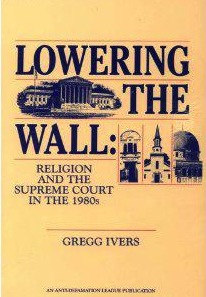
Lowering the Wall by Gregg Ivers

Lowering the Wall: Religion and the Supreme Court in the 1980s by Gregg Ivers

Publisher: The Anti-Defamation League
Release: 1999
Genre: Political Opinion


Lowering the Wall: Religion and the Supreme Court in the 1980s is an intriguing analysis of the erosion of church-state separation in a particular decade of American History. The author, Gregg Ivers, warns of the degradation of several important original intentions of the founding fathers. Written in 1991, this book provides a timeless insight into the dynamic and often conflicting political mindset of the 1980's.

With Lowering the Wall, Ivers has guided us through the disturbing evolution of the U.S. Supreme Court's standing on two of the most important concepts expressed in the Constitution: the freedom of religion and worship, and the separation of church and state. He repeatedly expresses his concern that during the 1980's, the Supreme Court began to noticeably depart from these vital constitutional values. 

One point that was consistently stressed by Ivers, was the rise of religious fundamentalism, or the rigid adherence to a religion in American society. This rise in zealous activism occurred mainly under the presidency of Ronald Reagan. Indeed, many fundamentalists received the backing of the Reagan Administration in various pursuits to undermine the concept of the separation between church and state. A couple of these shifty endeavors included reintroducing prayer to public schools, and influencing the content of school curricula and textbooks. These rigid fundamentalists also sought to benefit from government support (i.e. monetary endorsement) in a plethora of ways, including religious displays at the public's expense. At the same time this was occurring, intolerance toward less mainstream religious practices grew.  As one could reasonably infer, Ivers' feelings toward these happenings are in no way supportive. 

The author also provides an integral background of the original intent of the Constitutional Framers. They, being our founding fathers, sought to give citizens a choice in personal worship and religious practices. The government was to maintain a neutrality, and through the two religion clauses of the constitution, the Founders sought to find the balance between governmental support for religion, and lawful encroachments upon religion. Ivers points out the irony in today's situation; Supreme Court Justices professing fidelity to judicial restraint, or choosing to limit the exercise of their own power, while the 'law of the land' is seen to continually depart from the original intent of the Framers of the Constitution. It seems from Ivers' point of view that adhering to original intent is not one of the prime principles of many Justices. 

Probably one of the more important aspects of Lowering the Wall was Ivers' analysis of the relationship between majoritarian religions and the court, particularly the Rehnquist Court. Indeed, the author brings attention to the indisputable fact that a certain deference has been shown toward mainstream religious practices. Sadly, this respect and acknowledgement has not been extended to many unorthodox or minority religions. Minority groups, such as Native Americans, Black Muslims and Jews were all "overlooked" by the current court of the 1980s, which intended to minimize the importance of their personal religious beliefs while grossly over-promoting the importance of counteractive government interests. The rise in mainstream religious fundamentalism was obviously highly suppressive toward those of the non-mainstream variety, and Ivers is only too quick to point this out. 

As any perceptive person could see, Gregg Ivers is a man with an opinion. He knowledgeably demonstrates his take on the relationship between religion and politics of the 1980s. He aptly attributes the increasingly restrictive attitude toward unorthodox religious beliefs to the rise in religious fundamentalism under the Reagan Administration. Indeed, I believe Ivers was attempting to uncover the root of the problem: Reagan himself. In his presidency, Ronald Reagan appointed a total of 376 judiciary positions, the most by any president. Three of these were Supreme Court appointments, which reveals that Reagan's personal opinion held great sway over the entire judiciary system of the 1980s. 

In Lowering the Wall, Gregg Ivers places obvious emphasis on the biased nature of the courts in the 1980s. This political issue may be of no interest to some, but I find it a highly important matter, even today. Some may shrug this book off as a good example of liberal "nonsense," but I would dispute that claim. Ivers obviously favors the adherence of original intent, and who but the most staunchy of corrupt politicians could favor otherwise? At the time Lowering the Wall was published, Gregg Ivers was the Assistant Professor of Government at American University, and I am sure anyone who shrugs off his credentials is more than a little ignorant. This author provided highly legitimate sources to back his claims: direct accounts of the court cases concerning the scope of what his book covers.  It is my hope that this author's writings continue to be read by interested individuals and persist long into the future. 

Lowering the Wall: Religion and the Supreme Court in the 1980s is one of the most intriguing books I have ever had the chance to indulge. I must admit, the dry nature of Gregg Ivers' writing style was a mild hindrance to the readability, and yet I still enjoyed pondering his opinions. Ivers' goal is to bring awareness to the lowering of the wall between church and state in the 1980s. This slow but evident transformation of the government's interpretation of the two religion clauses took place over a decade. The evolution of America's outlook was heavily influenced by a largely conservative judiciary branch and the president himself. This book left me with the impression that government is not always progressing in the right direction, and may actually take steps backward at times. I believe this happened in the 80s, and could even be happening now. 

Readers should approach this book hesitantly. Although dry, it is strongly opinionated. Ivers is very straightforward with where his allegiance lies when it comes to the political battlefield. The way Ivers explains the reasoning behind the turmoil of the 80s largely places Republicans at fault. In this case, I don't know If I could blame him. It is of my opinion that all religious beliefs and practices are equal, or in fact, one and the same. Different names have similar meanings, and diverse practices have origins akin. By law, in the United States, government is to give no preferential treatment to one religion over another. Religion cannot be endorsed, nor can it be condemned. I believe this entire system was based on balance, of which our founding fathers were the prime constructors. Irreverence or a failure to adhere to this concept can only lead to more turmoil, and disrupt the already precarious relationship between government and the people. I urge and implore the people of our nation to open their minds, to see the broader outlook. This is vitally important if we are to remain unified and stoic in the coming times.

Overall, Lowering the Wall is an excellent read for those whose hearts are set on politics. I found it interesting myself, but than again I am a bit of political speculator. Gregg Ivers is truly an intelligent individual, capable of expressing his opinions in a subtle, yet lustrous manner. Readers should strive to understand the connections Ivers frequently demonstrates, and understand the points he makes about the referenced court cases. All in all, I discovered this book to be well-rounded and quietly powerful. 

Ivers, Gregg. (1991) Lowering the Wall: Religion and the Supreme Court in the 1980s. United States: Anti-Defamation League

Sunday, September 16, 2012

The House of Power (Atherton #1) by Patrick Carman

The House of Power by Patrick Carman

Publisher: Little, Brown and Company
Release: 2007
Image Source: Junior Library Guild
Other Titles in Series: The Rivers of Fire, The Dark Planet

Rating:
Characters- 17/20
Plot- 19/20
Writing- 18/20
Originality- 20/20
Recommendation- 20/20
Overall- 94/100 or A-

Synopsis: Dr. Harding is the futuristic mad scientist responsible for creating Atherton: a three tiered satellite world orbiting the fallen Earth. But those who live on Atherton don't know Earth exists or their role in trying to save it. Edgar, a gifted climber, is one of the first to discover the first of many startling revelations to come: the three tiered world of Atherton is collapsing. A dangerous world of strange creatures and hidden powers with a history locked inside the mad scientist, Atherton is much more than it appears at first glance. 

Review: The House of Power is the first installment of the Atherton trilogy; written and imagineered by Patrick Carman. This first installment details the many dangerous and revolutionary events on the mysterious land of Atherton. The plot itself is fairly simple and decent, being a fantasy written with an adolescent audience in mind. A likable protagonist named of Edgar is presented whose various endeavors and exploits the story revolves around.

The fabric of The House of Power is rich and textured, and coupled with a breeze-to-read writing style, it should greatly appeal to younger readers. Upon starting the first chapter, I was pleasantly enthralled by a gentle mystery. The ingenious Dr. Harding is portrayed as a mad scientist, which subsequently offered a glimpse into his experiment gone wrong—Atherton itself. Indeed, the world Carman imagined is both beautiful and tragic, a success and a disaster.

The satellite world of Atherton was constructed in the 22nd century, following the environmental collapse of Earth. Overbearing pollution and technological dominance ravaged Earth for many years, until it became known as simply The Dark Planet. The original plan of Atherton was to be a refuge from The Dark Planet, but its prime creator, Dr. Harding, held secret intentions. He held specific notions how a new utopia should be created. The Doctor even developed strict guidelines on how the biological and socio-political environments should be structured. In turn, Atherton was constructed based on a three-tier layout. The top level, called the Highlands, was the location of the only water source in Atherton, and the ruling class of citizens. Next is Tabletop, the middle tier and home of the lower class. In Tabletop, the residents farm sheep, rabbits, and a certain hybrid of figs. Most of these resources sent to the Highlands. The third and final level is called the Flatlands. This dark and barren place is filled with mystery and intrigue. No one from the top two levels has ever been to the Flatlands, and any past records are nonexistent.

As you can see, a dynamic power-play is evident between the two classes of residents on Atherton. The Highlanders control the only water source, and in turn take advantage of the power to invoke harsh demands on the lower class. Tabletop struggles to cater to their lords and must contend with living in near-poverty and intensive labor. Later in the novel, readers should recognize the stirrings of discontent and rebellion as the two classes fall closer together than anyone could imagine. The mystery of Atherton is finally revealed, and mind-blowing is truly the only way to describe the surprises sure to come.

The House of Power is a quick, entertaining read sure to win the hearts of any audience. Adolescents and tweens will especially enjoy the high level of excitement and action within its pages. I tip my hat to Patrick Carman, who is a master at building enjoyable fantasies.

Overall Grade: A- 
Atherton: The House of Power is a most interesting exploration of an alternative world—and the social relationships between its inhabitants. Despite Edgar's admirability, the characters of the book were lacking on a few fronts. Fortunately, the unique environment and well-rounded plot are plenty enough satisfy most readers.


Carman, Patrick. (2007) The House of Power. United States: Little, Brown and Company

Saturday, June 9, 2012

The Eye of the World (The Wheel of Time #1) by Robert Jordan

The Eye of the World by Robert Jordan

Publisher: Tor Fantasy
Release: 15 Nov 1990 (832 pages)
Image Source: Splash of Our Worlds
Other Titles in the Series: Check here

Rating:
Characters- 20/20
Plot- 19/20
Writing- 20/20
Originality- 19/20
Recommendation- 20/20
Overall- 98/100 or A+

The Wheel of Time turns and the Ages come and go, leaving memories that become legend. Legend fades to myth, and even myth is long forgotten when the Age that gave it birth returns again. In the Third Age, an Age of Prophecy, the World and Time themselves hang in the balance. What was, what will be, and what is, may yet fall under the shadow. 


Review: The Eye of the World has proven to be an in-depth, well thought, and breathtaking read. Robert Jordan has imagined a truly vivid world, where events seems to fly by at breakneck speed. Something about this book, maybe its tangibility, or the soul encased in its writing, will keep readers enthralled.  As mentioned, this fantasy's plot is very fast paced, which greatly bumps up the excitement level.

Something truly astounding in my mind is the sheer detail Robert Jordan crafted into his novel. He seems to have an incredible eye for cause and effect relationships, which leads me to believe he would be a good historian. Indeed, reading The Eye of the World is a bit like reading history. In that sense, I could compare him to J.R.R Tolkien. Truly impressive work.

The Wheel of Time also incorporates a very detailed magic/belief system, unlike that of The Lord of the Rings. At the beginning of time, a Creator forged the universe and the Wheel of Time, which turns for eternity and weaves all lives. The wheel has seven spokes, and each represents an age. The magic in The Wheel of Time series is called the One Power. This form of magic is stemmed from something called the True Source, which powers the Wheel of Time. The One Power is dualistic, kind of like Yin and Yang, but instead is called saidin and saidar. Men are able to wield the saidin aspect of the One Power, and women the saidar. Not all people can use the One Power.

I found many similarities between Jordan's system of magic and eastern religions in our world. The Wheel of Time concept is derived from Hindu and Buddhist teachings, while the True Source and saidin and saidar are reminiscent of Taoism. All in all, it makes for an interesting book.

Truly, The Eye of the World is a spectacular read for lovers of fantasy epics. It is detail rich and very fast paced. Sometimes the plot may seem a bit predictable or cliche, but it is still satisfying nevertheless. I've heard that the series is long (13 books and still going) but I plan on reviewing every one in the coming months.

Overall Grade: A+
The Eye of The World combines the best of fantasy: a mysterious history, vibrant characters, and an intense plot. Readers should notice Jordan's eye for details and appreciate the incredible story he has woven. Anyone planning on reading the series is surely in for an incredible journey of 13 books. Personally, I can't wait to embark!


Jordan, Robert. (1990) The Eye of the World. United States: Tor Fantasy 

Sunday, March 18, 2012

Ptolemy's Gate (Bartimaeus Trilogy #3) by Jonathan Stroud

Ptolemy's Gate by Jonathan Stroud


Publisher: Doubleday
Release Date: 2005
Synopsis Source: Amazon
Other Titles in Series: The Amulet of Samarkand (#1), The Golem's  Eye (#2), The Ring of Solomon (prequel)

Rating:
Characters- 20/20
Plot- 19/20
Writing- 19/20
Originality- 18/20
Recommendation- 20/20
Overall- 96/100 or A

Synopsis: Three years have passed since the magician Nathaniel helped prevent a cataclysmic attack on London. Now an established member of the British Government, he faces unprecedented problems: foreign wars are going badly, Britain's enemies are mounting attacks close to London, and rebellion is fermenting among the commoners. Increasingly imperious and distracted, Nathaniel is treating Bartimaeus worse than ever. The long-suffering djinni is growing weak and vulnerable from too much time in this world, and his patience is nearing its end.


Meanwhile, undercover in London, Kitty has been stealthily completing her research on magic, demons, and Bartimaeus's past. She has a plan that she hopes will break the endless cycle of conflict between djinni and humans. But will anyone listen to what she has to say?


In this thrilling conclusion to the Bartimaeus trilogy, the destinies of Bartimaeus, Nathaniel, and Kitty are thrown together once more. For the first time, we will learn the secrets of Bartimaeus's past, and get a glimpse into the Other Place—the world of demons—as together, the threesome must face treacherous magicians, unravel a masterfully complex conspiracy, and defeat a formidable faction of demons. And worst of all, they must somehow cope with one another...


Review: The last book in a series always manages to woo me a bit. I may just be a sucker for profound endings, but I don't know. Ptolemy's Gate sure had this same effect on me. I found myself reading wantonly, like I used to do when I was little. The words flew by my eyes so quick, and I barely gave myself time to take notes for the review. Funnily enough, the notes I did take disappeared mysteriously a couple days ago. I'm winging it now that my precious scribbles are lost.

Anyway, back to the book. Ptolemy's Gate is the third and final installment of the Bartimaeus trilogy. It concludes the series nicely, and leaves readers with some interesting surprises. I found the entire series, but this novel especially, very ambitious. It attempts to mingle otherworldly and esoteric concepts such as space-time-continuums with a slew of true historical facts. All of this is laced with the usual sarcasm and satire of Bartimaeus, the quick-witted protagonist, The comical aspects of the dialogue are hilarious, as fans of the series already know.

Back to the esoteric topics—Jonathan Stroud obviously has an inspired interest in theoretical physics, and possibly the occult. He provides a very interesting description of the Other Place, the non-physical realm of demons and djinn. Here is a description from The Bartimaeus Trilogy Wiki:

The Other Place is a realm of chaos, in which there is no matter but infinite 'essence', which is described as a mass of swirling colours with no borders or boundaries, somewhere between gas and liquid. Time runs at a different rate in the Other Place compared to the human world, although it is not made completely clear in the Bartimaeus Trilogy exactly what relationship between the two timescales is. 
What really intrigues me is the so called 'essence.' Being a fan of the esoteric myself, I can only wonder as to what the author is alluding to. Another description offers some more insight:

In the Other Place, all demons are one, and so their collective essence is a single conscious entity. This allows demons to heal from damage sustained in the human world, while also putting the exact mechanics of the Other Place beyond reach of genuine human understanding. Human consciousnesses that visit the Other Place require something to focus their consciousness on and are able to impose their will to a certain degree on the essence of the Other Place, moulding it to specific shapes. Although demons are much better at this than humans, and it does not apparently cause them any harm. However, they prefer not to do it, and appear to actively resent outsiders attempting to impose order upon their realm.  
Make of this what you will. I found it highly interesting, and if a chance to interview the author pops up, I will question him about this. In a way, it kind of reminds me of Shamanism and how shamans work with consciousness to connect to the spirit world. While in this world, they consult with 'spirits' for aid in healing and medicinal purposes. Anyway, it's food for thought.

In Ptolemy's Gate, readers began to notice connections between the fact the Bartimaeus frequently takes on the figure of Ptolemy and Kitty's desire to see demons and humans coexisting. Readers become enlightened by the possibility of these two types of entities working together, for the greater good. Bartimaeus talks in awe about a human actually traveling to the Other Place. He explains how the Other Place is where spirits are free and permeable and basically twirl in kaleidoscopic beauty intermingling with forgotten fragments of a dream or bits of some long-lost memory.

Spoiler alert!

The series ended on a slightly surprising note (or not) with the death of Nathaniel. Nathaniel finally opened up and showed his true integrity towards the end of this final book. He saved Bartimaeus and sacrificed himself in the process to save those he loved most. To tell you the truth, it was a bit of a cliffhanger. There were a few loose ends that could have been tied up. I believe the author intended this.

Overall Score: A
All in all, Ptolemy's Gate is a satisfying conclusion to the Bartimaeus Trilogy. Jonathan Stroud portrays the best of character development in Nathaniel, and of course, captures the essence of Bartimaeus once again. Readers should find his descriptions of the Other Place from a demon's perspective interesting and maybe a tad beautiful. This is a fantastic book!


Stroud, Jonathan. (2005) Ptolemy's Gate. United States: Doubleday

Sunday, February 19, 2012

The Cloudy Corners of Creation by Mark Tate


Publisher: Outskirts Press.
Release Date: 2012
Image Source: link

Synopsis: Dr. Tate has written an introduction to the subject of the paranormal for seekers of all faiths, especially Christians. He has surveyed a large number of books, articles, websites, television, and radio programs in his presentation of the subject of the paranormal for those who might normally shy away from the subject. Included are chapters on UFOs, near death experiences, prophecy from non-Christian sources, and a host of other subjects. Anyone interested in the paranormal from a sympathetic but questioning perspective will enjoy this read. 

Review: When I heard of this book, I knew I had to request a review copy. The Cloudy Corners of Creation is right up my alley; a book that comprises an open-minded take on spirituality and a speculative look at the paranormal and occult. Mark Tate is a brilliant author and human. He is strong and resolute in his faith, yet still sympathetic towards those of differing beliefs. He realizes that ignorance is not the path to tread and takes steps to learn from non-Christian sources. One quote from his book on page 71 proves how open he really is and gives insight on a momentous yet true vision:

At this point in time, what is most needed in this world is understanding between different spiritualities and religions of the truth of who and what they are, what they practice, and what they believe.

This truth rings clear throughout his book as Tate tries to uncover or at least bring attention to the cloudy corners of God's great creation. I can't commend him enough for his bravery of walking where other Christians fear to tread. I hope his actions inspire others to blaze their own trails and realize dogma can be interpreted in more than one way. 

There was a tremendous amount of research put into this book, enough to satisfyingly back up the evidence Tate gives on the possible existence of the paranormal. The only criticism anyone could have is a lack of strong conclusion. Tate presents many questions in his book—with the support of strong evidence—but doesn't wrap it up in a superbly satisfying way. I personally don't consider this a failure. How else could one conclude a book on pseudoscience? Definite answers cannot be given. Instead, readers should look for insight that the author offers on spirituality and the fate of humanity. As he states on page 152:

...Perhaps God's voice is quietly being whispered through many diverse places by diverse peoples to warn the world—You have used and abused the poor, the needy—men, women, children—all created in the image of God—for all of human history. You have raped and pillaged the earth—given by God to humanity to care for—for hundreds of years. You have acted as though the most evil things—murder, rape, neglect of parental duty, civilization's laws, and your own consciences—taught by all religions—were approved by God or gods—you have made the end to be near—and it is...

If this message is to be taken literally, you will understand its foreboding nature. Humans have sinned nearly incessantly in all of recorded history. When Judgment Day arrives—if there is such a thing—our fate is sealed in a nice high quality envelope. Postage paid. Are we to pay for our misdeeds? Will God have mercy? Currently, faith is providing the only answer.

From reading The Cloudy Corners of Creation, I have learned much. I realize that we have to look at the unknown with both our eyes and our heart, and only then can understanding the truth become possible. I thank Mark Tate for this stunning realization.

All in all, as my first ever non-fiction review, things went pretty smoothly. The Cloudy Corners of Creation is an insightful read on the more speculative aspects of nature. Readers who are interested in the paranormal and occult with undoubtedly savor this. I look forward to a possible interview with the author which is always a plus. So until then, faithful readers, au revoir! 


Tate, Mark. (2012) The Cloudy Corners of Creation. United States: Outskirts Press

Sunday, February 5, 2012

The Golem's Eye (Bartimaeus Trilogy #2) by Jonathan Stroud

The Golem's Eye by Jonathan Stroud

Publisher: Hyperion Books
Release Date: 2006
Image Source: link
Other Titles in Series: The Amulet of Samarkand (#1), Ptolemy's Gate (#3), The Ring of Solomon (prequel)

Rating:
Characters- 20/20
Plot- 19/20
Writing- 19/20
Originality- 19/20
Recommendation- 20/20
Overall- 97/100 or A

Synopsis: At only fourteen, Nathaniel is a rising star: a young magician who is quickly climbing the ranks of the government. There is seemingly nothing he cannot handle, until he is asked to deal with the growing Resistance movement, which is disrupting London life with its thefts and raids. It's no easy task: the ringleader Kitty and her friends remain elusive, and Nathaniel's job — and perhaps his life — are soon at risk. As the pressure mounts, he is distracted by a new series of terrifying attacks in the capital. But is it the Resistance again, or something more dangerous still? To uncover the perpetrators, Nathaniel must take desperate measures: a journey to the enemy city of Prague and — worse — summoning once again the troublesome, enigmatic, and quick-witted djinni, Bartimaeus. Meanwhile, Kitty and her fellow rebels are planning their most daring exploit of all — one that will make their fortune and change the history of London forever.


A thrilling sequel to the best-selling Amulet of Samarkand, The Golem's Eye is a roller-coaster ride of magic, adventure, and political skullduggery, in which the fates of Nathaniel, Bartimaeus, and Kitty explosively collide.

Review: The Golem's Eye is a fantastic sequel to it's predecessor; The Amulet of Samarkand. It could very well comprise the heart of the Bartimaeus Trilogy. The fast-paced turn of events invokes the childhood glee I used to experience during all my reading endeavors.  I enjoyed the return the protagonist—the sharp-tongued djinni that everyone should now be familiar with. Nathaniel was portrayed as slightly more aggressive than the previous novels, and his ambitions have anything but waned.

Since The Golem's Eye takes place a couple years after the events in Amulet, readers should note how character relationships have changed, along with the positions those characters now hold. Indeed, Nathaniel's increased aggression is probably the result of his rise to power in the government. He now holds commoners as beneath him—Although, hasn't he always? I found Nathaniel's antics hilarious as he continually proves his arrogance. His yearning for fame and recognition is pitying at times.

The character that truly struck me the most was probably Kitty Jones. She is both valiant and rebellious, but for the right reasons. Her truthful character is strong, a blockade of fortitude built by her past. She understands the nature of the commoner's position, and the many flaws in the dominance of the magicians in society. Kitty stands for what she believes in, and values her partners as both friends and comrades. I have more sympathy for her, than Nathaniel.

Also, the character Bartimaeus is becoming increasingly mysterious. As readers become more familiar with his humor and personality, they are undoubtedly curious about the djinni's past. Maybe we'll get some insight on these mysteries in the next book, Ptolemy's Gate.

Overall Grade: A
The Golem's Eye is a superb sequel to The Amulet of Samarkand. It is the cleverly engineered, second installment of the Bartimaeus Trilogy. Anyone should should love this, I definitely did. Readers should try to understand the motives behind both Kitty and Nathaniel. Finding out what drives them will lead to a richer experience while reading. Also, the perplexing mysteries of Bartimaeus are as great as ever, but one step closer to being solved. I bid you adieu an invite you to check out this excellent series (if you haven't already). 


Stroud, Jonathan. (2006) The Golem's Eye. United States: Hyperion Books. 

Sunday, January 29, 2012

The Amulet of Samarkand (Bartimaeus Trilogy #1) by Jonathan Stroud

The Amulet of Samarkand by Jonathan Stroud

Publisher: Hyperion Books
Release Date: 2003
Image Source: link
Other Titles in Series: The Golem's Eye (#2), Ptolemy's Gate (#3), The Ring of Solomon (Prequel)

Rating:
Characters- 20/20
Plot- 19/20
Writing- 20/20
Originality-19/20
Recommendation- 19/20
Overall- 97/100 or A

Synopsis: Nathaniel is eleven years old and a magician's apprentice, learning the traditional arts of magic. All is well until he has a life-changing encounter with Simon Lovelace, a magician of unrivaled ruthlessness and ambition. When Lovelace brutally humiliates Nathaniel in public, Nathaniel decides to speed up his education, teaching himself spells way beyond his years. With revenge on his mind, he masters one of the toughest spells of all and summons Bartimaeus, a five-thousand-year-old djinni, to assist him. But summoning Bartimaeus and controlling him are two different things entirely, and when Nathaniel sends the djinni out to steal Lovelace's greatest treasure, the Amulet of Samarkand, he finds himself caught up in a whirlwind of magical espionage, murder, and rebellion.

Review: The Amulet of Samarkand is a quick, witty, and fast-paced fantasy. It is the first of the Bartimaeus trilogy, and in my opinion quite an eye-opener. I enjoyed this novel greatly, the wide palette of characters was quite striking. I particular enjoyed the thoughts of the lead character, a sarcastic and often narcissistic djinni. They were cleverly expressed in footnotes, which added to the character's. . . finesse I should say.

Jonathan Stroud has created a very interesting fantasy world. In fact, I would classify it as an alternative history. Taking place in London, the seat of the modern-day British Empire, the plot revolves around Nathaniel, a preteen magician. London is riddled with such magicians, who comprise the ruling class of society. They control every aspect of the government, and summon powerful spiritual entities to keep citizens in check. Nathaniel is apprenticed to a fairly low-ranking magician, who he often holds in contempt. His ambitions surpass anything his master has achieved.

A pretty good book in general, The Amulet of Samarkand is sure to give anyone a laugh. I myself enjoyed it greatly. There is much to uncover about the mysterious Bartimaeus, which I'm sure readers will do in later novels. I believe, after I've reviewed the entire series, I might send Stroud an email requesting an interview. I hadn't planned on requesting authors directly, but I'm very eager to have a conversation with this one.

Overall Grade: A
The Amulet of Samarkand is a good book for those who like sarcasm and often narcissistic characters. A fairly fast read, it's sure to appeal to most people and give anyone a chuckle. Bartimaeus is a particular interesting character, one I believe will develop over the course of the series. Jonathan Stroud is a great writer, and I hope he will continue being so into the future.


Stroud, Jonathan. (2003) The Amulet of Samarkand. United States: Hyperion Books.